September 12–27 2026: Simon Boccanegra
September 20– October 4 2025: Thea Musgrave’s Mary, Queen of Scots
October 15- November 1 2026: Manon
October 31- November 29 2026: Le Nozze di Figaro
November 6 2026: Strauss in Concert
May 29- June 22 2027: Das Rheingold
June 4– July 2 2027: Tosca
June 25 2027: Pride Concert
San Francisco Opera’s 104th season was announced yesterday. Six operas will be presented in the 2026-2027 season, along with a performance of Strauss and a special Pride Concert.
Music Director Eun Sun Kim will conduct the Verdi, Massenet, and Strauss this fall and returns for Wagner in 2027.
Philharmonia Baroque Orchestra and Chorale presented a program entitled Jewish Nightlife: Hebrew Poetry, Kabbalah, and Coffee (ovation pictured) last night at Congregation Emanu-El. This evening of chamber music, led by Maestro Nicholas McGegan, was jaunty and charming.
Scholar-in-Residence Francesco Spagnolo took us through the rationale for including the various pieces and conversed with McGegan. It was an exploration of Jewish communities utilizing nighttime to reflect, resist, and renew, all very timely sentiments.
A chamber ensemble formed by seven members of PBO played, including McGegan on harpsichord. The two instrumental pieces were both evocative, Luigi Boccherini’s La musica notturna delle strade di Madrid was sprightly and Antonio Brioschi’s Sinfonia in G Major (from 1733 Casala Monferrato Hebrew cantata) was vivid.
The rest of the recital included much singing, including soloist Yair Harel, who also played a Middle Eastern frame drum for certain songs and the Philharmonia Chorale Quintet whose members included a soprano, a mezzo, two tenors, and a bass-baritone.
It was clear all the singers were carefully selected, they all sounded distinctive but blended beautifully. Harel has a light, bright voice with much sweetness that is just right for this space. The quintet supported him nicely.
Of the Piyyut, the Hebrew sacred poetry from the Mediterranean and Middle East, Achot qetanah (Little Sister) had a particular clarity.
Salamone Rossi’s Hashkivenu (Cause Us to Lie Down) was very lovely and his Pargoletta che non sai (Little girl, you don’t know) was funny and acted well.
Cantata Ebraica in Dialogo (Hebrew Cantata in Dialogo) by Carlo Grossi was buoyant and rounded off the performance. There were cookies and coffee served afterwards.
* Tattling *
It was so nice to hear theorbist Adam Cockerham in this program, as he lives on the East Coast. I was surprised and pleased to run into him, his wife, and my date for the evening chatting in the lobby just before the performance.
The audience was extremely attentive and well-behaved. The only extraneous noise heard was one door to the stage that was shut loudly during Dodi ‘arad le-gano.
McGegan is a humorous presence, his conversation with Spagnolo was engaging and cute. The maestra managed to summon the violins for the Rossi by snapping his fingers.
The San Francisco Symphony, with John Storgårds, Conductor, perform Outi Tarkiainen’s “The Rapids of Life,” (U.S. Premiere), Shostakovich’s “Piano Concerto No. 1” with Seong-Jin Cho, Piano, and Mark Inouye, Trumpet, and Beethoven’s “Symphony No. 5.” At Davies Symphony Hall on Thursday night, January 22, 2026.
* Notes *
This week Finnish conductor John Storgårds led the San Francisco Symphony in the U.S. premiere of Outi Tarkiainen’s The Rapids of Life (2023). The concise piece concerns child birth and has all kinds of interesting textures and shapes in it.
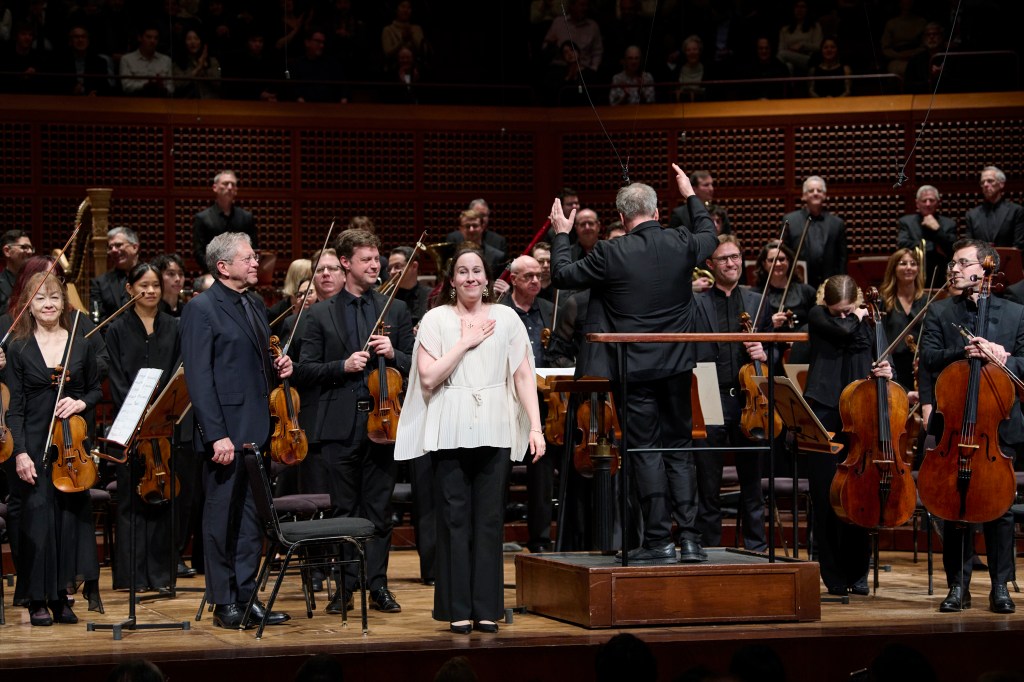
Tarkiainen (pictured, photograph by Stefan Cohen) learned about the death of fellow female Finnish composer Kaija Saariaho as she wrote this work, and she dedicated it to Saariaho. There is a reference to Saariaho’s cello concerto Notes on Light at the beginning of Tarkiainen’s piece.
The Rapids of Life follows the wave-like nature of giving birth, the orchestra sounded like gossamer, very shimmery. The instrumentation includes a dozen percussion instruments such as glass wind chimes and tubular bells, and therefore has many layers of rhythmic texture.
Storgårds seemed like he had a good rapport with the orchestra, he seems very genial and warm. The musicians were together and strong.
Paired with the new piece was Shotakovich’s Piano Concerto No. 1 in C minor, which is quite fun and features solo trumpet with the piano and strings. Pianist Seong-Jin Cho played rather aggressively, there was a bit in the middle when trumpet player Mark Inouye has a solo and Cho comes in with one note, his definitive attack was humorous.
Cho had some lovely quiet passages, it is obvious his technique is flawless. His phrasing was less than lyrical, at times it was a contrast to Inouye’s smooth legato. The strings glittered and were supportive. Cho and Inouye played together in an encore, and Cho’s playing and manner were gracious.
Beethoven’s Fifthwas likely the big draw of the evening, and the audience on Friday night looked youthful, lively and full. The orchestra sounded robust. Storgårds had a good handle on the musicians, the playing was bright and very pleasant. I particularly noticed the woodwinds, especially the flute.
* Tattling *
We were seated across the aisle from the composer Outi Tarkiainen, who addressed the audience before the performances and introduced her piece. I enjoyed that she stayed not only for Shostakovich but for Beethoven after the intermission.
There was a mother with two small children in Row K 101-105. The kids were quiet, though the younger one did swirl her beverage making sounds with her ice during the 5th. However, the mother had her mobile phone out the entire time and brought her children in late after intermission.
There were numerous cellular phone rings. During a quiet part of the slow movement of Shostakovich we heard three rounds of cricket chirps from the center of the orchestra level and we heard a different ring in the third movement of the Beethoven.
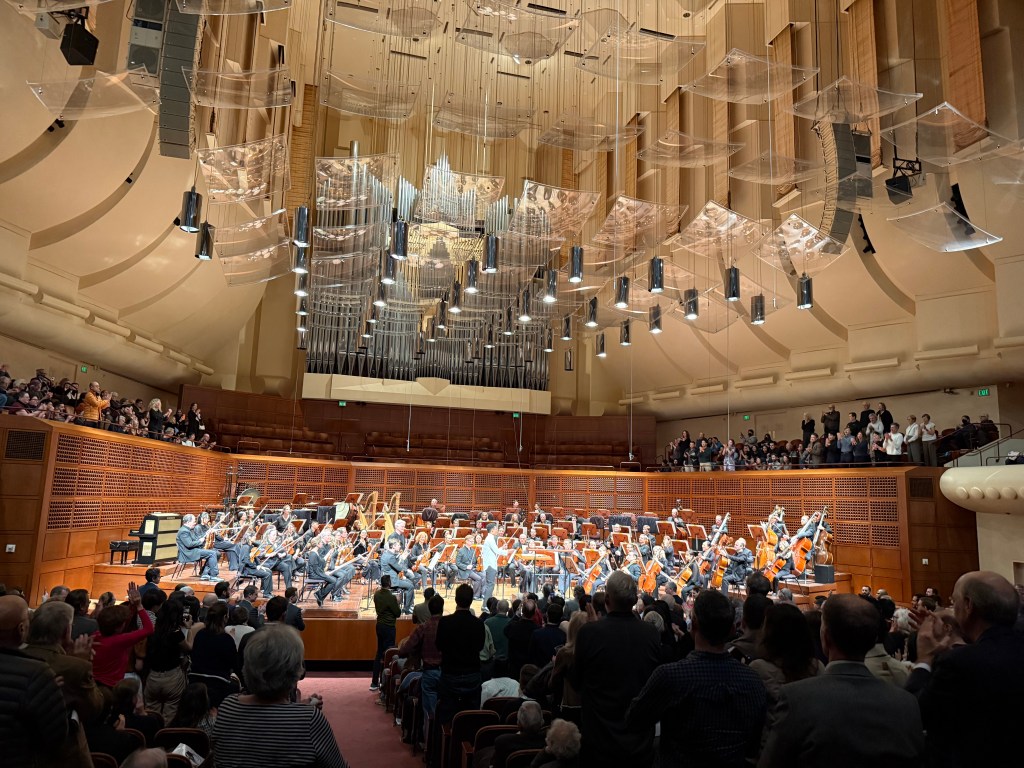
British conductor Edward Gardner led the San Francisco Symphony in an audience-pleasing concert of Holst’s The Planets and Bruch’s Violin Concerto No. 1 in G minor last night. Gardner has a lot of energy and ideas, and the orchestra sounded wonderfully shimmery.
I had never heard The Planets live, and the piece is nearly an hour long, divided into seven movements. I thought it was interesting that Earth was not among these. There is a great range of moods based on the planet at hand, Mars, the Bringer of War that starts the work is bombastic and extremely loud, while Venus, the Bringer of Peace is, as to be expected, much more calm and gentle.
It was clear that Gardner knows the piece well, and he drew out the best from the orchestra. The different emotions of each movement were well-defined, and Gardner did not shy from being brusque, which was interesting to hear, usually we don’t hear harshness from this group of musicians, at least not intentional harshness.
The fleetness of Mercury came through, as did the “jollity” of Jupiter. The chorus was extremely spooky in the ethereal last movement, Neptune, the Mystic. It was hard to tell where the singers were in the hall from the orchestra level, they seemed above us, but this was effective and eerie
The first half of the concert began with the first performances of Vaughan Williams’ Overture to The Wasps (1909) at San Francisco Symphony. This music was for Aristophanes’ play, and had a good range from insectile to pastoral.
Best of all may have been the Violin Concerto by Bruch, with Randall Goosby as soloist. Goosby has a lot of warmth and refinement. His technique is flawless, the bowing seemed exact. He sounded quite lovely with the orchestra and seemed to sincerely appreciate his fellow musicians. It was nice to hear how fluidly he played, supported by the orchestra, and I enjoyed how unflashy Goodsby is. His encore was Louisiana Blues Strut by Coleridge-Taylor Perkinson, which was a joy to hear.
* Tattling *
This performance looked to be very well attended, nearly all the seats around us were full. There was very little whispering or electronic noise. At least two people dropped objects during the first movement of the Bruch, and this was so audible since these moments were during the solo violin parts without the orchestra.
Someone in one of the orchestra level boxes was incensed by another audience member in the side orchestra, house left, around Row S or T. She hissed at the person, I imagine they must have been filming with their mobile phone during Jupiter, the Bringer of Jollity.
Gardner spoke to the audience before he started the music, joking about his hair color being different from the last time he was at San Francisco Symphony and explaining the pieces. He mentioned that British composers were very influenced by Brahms.
The 2025 Adler Fellows (pictured, photograph by Kristen Loken) had their concert last Friday at Herbst Theatre in San Francisco. Every season we see and hear these apprentice artists in supporting roles on the main stage of San Francisco Opera, so it is nice to have a program completely focused on them.
had their concert last Friday at Herbst Theatre in San Francisco. Every season we see and hear these apprentice artists in supporting roles on the main stage of San Francisco Opera, so it is nice to have a program completely focused on them.
Conducted by Ramón Tebar, the San Francisco Opera Orchestra accompanied the young singers, but the evening did start with the overture from Die Fledermaus. It was very jaunty and fun.
There was much fine singing of very famous arias, duets, and ensembles. The singers have very loud, clear voices. The performance was directed by Omer Ben Seadia, and was quite naturalistic and worked just fine.
Bass-baritone Jongwon Han did equally well with “Tutto è disposto – Aprite un po’ quegli occhi” from Le Nozze di Figaro and “il mulino il fonte il bosco.. vi ravviso o luoghi ameni” from La Sonnambula. There was a lot of ease to his sound.
Baritone Olivier Zerouali was very enjoyable in “Largo al factotum” and quite charming. He was also quite good in the trio from “Nein, mit solchen Advokaten” from Die Fledermaus as Dr. Blind with soprano Georigiana Adams as Rosalinde and tenor Samuel White as Eisenstein. Everyone seemed quite well matched and strong.
Soprano Mary Hoskins is one to watch, her “Es gibt ein Reich” from Ariadne auf Naxos was seamless. The Wagnerian duet she sang with tenor Thomas Kinch was an intense finale for the performance. “Wehwalt heißt du fürwahr…Siegmund heiss ich” from Act I of Die Walküre was nothing short of impressive. One can only imagine that Hoskins will be in the upcoming Ring and also in the performances leading up to the full cycles in 2028.
* Tattling *
The audience included many familiar faces and as such was rather well-behaved. There was very little talking or electronic noise. A very small and happy infant was also in attendance and seemed nonplussed by the singing.
Ercole Amante (ovation pictured, photograph by author) premiered at ODC Theater from Ars Minerva this past weekend. The piece by Antonia Bembo was written in 1707 and features absolutely beautiful music. It is startling that Ars Minerva can keep finding these obscure operas that are all so lovely.
The production directed by Céline Ricci, leans into the absurdity of a convoluted plot, which involves Hercules falling in love with Iole whose father he killed and who is loved and in love with Hercules’ son Hyllus. There are the usual projections to switch the scenes plus various props including a bear rug and a deer head.
Conductor and harpsichordist Matthew Dirst did not have the small orchestra particularly together, though the prettiness of the music did come through. Likewise the singers were not always exactly with the instruments.
There was much fine singing from many people we are accustomed to hearing at Ars Minerva. I always like hearing mezzo Nina Jones (Licco) and contralto Sara Couden (Paggio), both these artists have smooth, rich voices and do humor well.
Soprano Lila Khazoum makes for a clear-voiced Iole and sounds nice with tenor Max Ary as Hyllo, whose burnished sound is quite pleasant. His high register does sound slightly strained.
Mezzo-soprano Kindra Scharich’s resonant tones as Deianira are sympathetic. The contrasting sopranos of Melissa Sondhi (Venere) and Aura Veruni (Giunone) really work well, Sondhi is more bird-like and Veruni more icy. Baritone Zachary Gordin certainly looks the part of Ercole, his bare torso is impressive but his voice could have been smoother, and he seemed to forget a line on Saturday night and had to consult the score, as there was no prompter.
* Tattling *
There was a supertitle right before the music started explaining that the dead bear and deer were not killed specifically for this performance.
Many entrances were made through the audience, and one of my companions was brushed against by Aura Veruni’s rather bulky gown at one point.
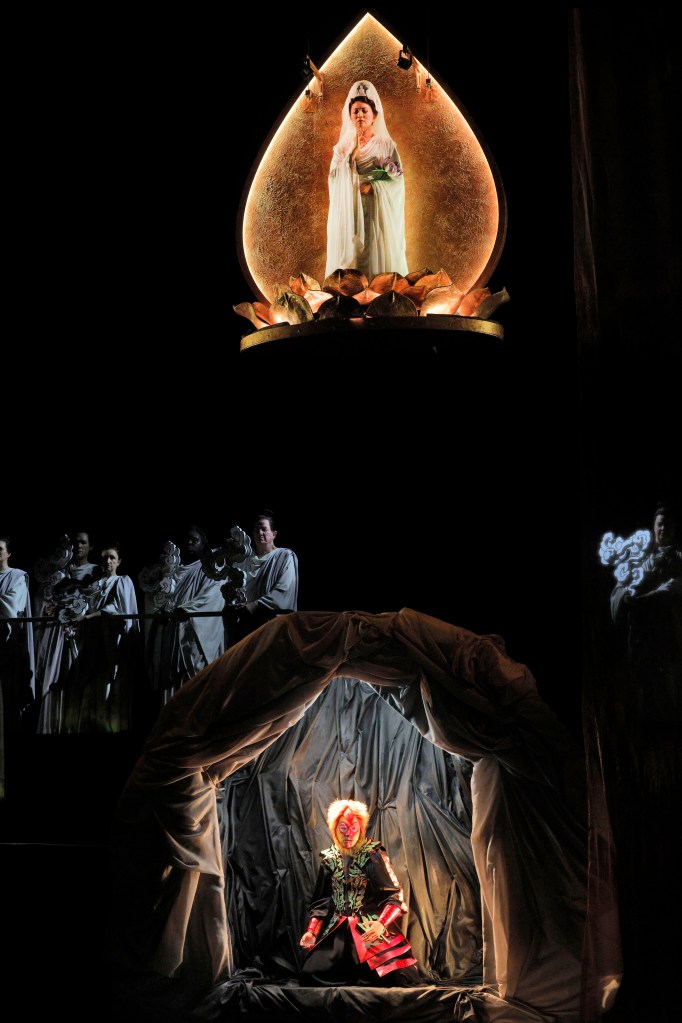
The Monkey King (Act I pictured, photograph by Cory Weaver) had a world premiere last night at San Francisco Opera. Composed by Huang Ruo and with a libretto by David Henry Hwang, this new opera is a spectacular piece of theater.
Director Diane Paulus’ production features puppetry, projections, and dancing. Basil Twist’s set design has many layers to it and employs a lot of cloth, either draped or as curtains.There was always something to look at, and there were many bright colors.
It was disorienting to hear the San Francisco Opera Orchestra play Wagner the night before to this contemporary work by Huang Ruo. Maestra Carolyn Kuan kept the orchestra moving, but the sound was more diffuse than with Music Director Kim.
The orchestra included a pipa, a four-stringed Chinese lute played by Shenshen Zhang. Huang Ruo’s music at times has lots of repeated arpeggios and novel percussion such as Indonesian button gongs, a Chinese opera gong, and Chinese crash symbols. The textured, atmospheric sounds were enjoyable to listen to and sustained the drama.
Commissioned by San Francisco Opera in partnership with the Chinese Heritage Foundation of Minnesota, the story is based on the beginning of the classic novel Journey to the West from the Ming Dynasty. David Henry Hwang’s libretto is mostly in English with some Mandarin sprinkled in, which somehow works fine. Hwang is very funny, and it is suitable for the adventures of the Monkey King. Some choice lines included “Awesome” and “This Buddha is so dumb,” which are less amusing in isolation but in context engaged the audience.
The chorus sounded great, it’s so impressive that these singers went from entirely different music in a heartbeat and are so cohesive. The principals are also strong. Tenor Kang Wang had a very fine Company debut in the title role of this opera. He’s very appealing, both in his pretty voice and his physical presence. Tenor Konu Kim sounded bright and blustery as the Jade Emperor. Best of all was perhaps soprano Mei Gui Zhang as the goddess of mercy Guanyin. Her voice is so clear and smooth, she truly embodied this part.
Another stand out is bass Peixin Chen, as Supreme Sage Laojun. The depths of his sound are commanding. Baritone Jusung Gabriel Park sang Master Subhuti very beautifully, with humor and graveness in turns as appropriate.
I also enjoyed hearing former Adler Fellow baritone Joo Won Kang as both Dragon King Ao Guang and Lord Erlang. Mezzo-soprano Hongni Wu made her own notable contributions as the Crab General and Venus Star, and it was nice to hear another vocal type amid so many tenors, baritones, and other male voices.
* Tattling *
The audience was very excited for this performance, and seemed to rapt by the action. I heard some light talking but not much electronic noise, but perhaps that is a function of how loud much of the instrumentation was.
Many fancy people were celebrating the work on the box level of the opera house, including former Speaker of the House, Nancy Pelosi.
Last night was the fifth and final performance of Parsifal at San Francisco Opera. I attended in balcony standing room and the sound of the orchestra under Maestra Eun Sun Kim was better than ever, lucid and shimmering. The chorus is likewise very powerful and together.
The singing was strong though tenor Brandon Jovanovich (pictured as Parsifal with Kwangchul Youn as Gurnemanz, photograph by Cory Weaver) started feeling ill during Act II, and General Director Matthew Shilvock appeared on stage before Act III to say Jovanovich would graciously sing the rest of the performance despite not being well. There were some moments in Act III that Jovanovich was clearly not singing out and sounded fragile, but he made it through the opera.
* Tattling *
The audience at the back of the balcony was pretty quiet until Act III. A young woman in Row L Seat 121 talked a lot during the music and filmed the performance. I eventually moved myself away from her as she kept talking even after being hushed. There were some mobile phone rings heard, and some hearing aid feedback as well.
Many people were very excited about the announcement on Tuesday that Wagner’s Ring Cycle is coming back to San Francisco Opera in Summer 2028, with Maestra Kim conducting and Brian Mulligan as Wotan. I was asked if I would attend all the performances, and judging by my perfect Parsifal attendance, I think it is likely.
Yesterday evening I went to the fourth performance of San Francisco Opera’s Parsifal San Francisco Opera and read the score in standing room. The way Maestra Eun Sun Kim has set up the strings is novel, she has the violins in the middle, the cellos on the outside to her left, and the violas to her right.
Having the violas exposed made them stand out more to me, and it was easy to hear their lines from the back of the balcony. The playing of the whole orchestra keeps getting better and better. It was especially lovely hearing the clarinet soli and the harps, and it was fun to follow the music with the score.
The singing is consistent, everyone sounds very appropriate for their roles. Hearing mezzo-soprano Nikola Printz (A Voice) from the balcony was intensely beautiful, it was easier to appreciate from this location, even though the singer doesn’t appear on stage regardless. Tenor Brandon Jovanovich (pictured, photograph by Cory Weaver) is truly a fine Parsifal, and it was great to be able to hear him yet again.
* Tattling *
There were very few tickets sold for standing room, but since there were so many latecomers to the 6pm performance, it was quite crowded in the balcony. There were very many young people, and one wanted to read the score with me at the end of Act I.
A person whose cellular phone was ringing during Act II rushed out of the hall, but gave me quite a start as he was passing me as the ring tone went off, and I almost thought it was my phone as I use the same one.
The Doechii show at Bill Graham got out at the same time as the opera performance, and it was surreal trying to get to BART with so many young people.
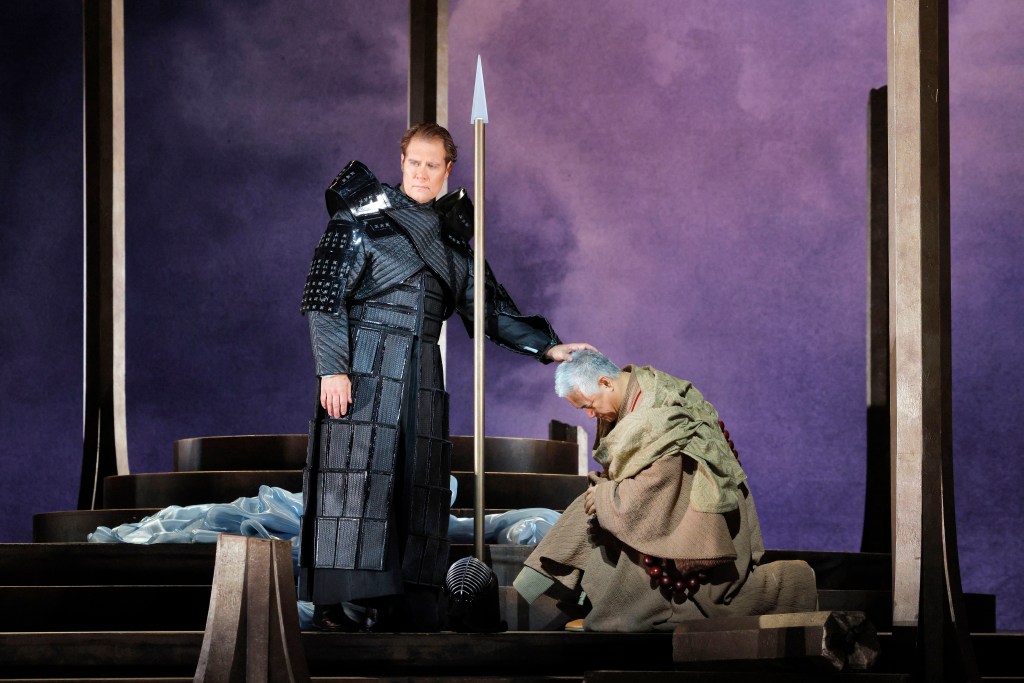
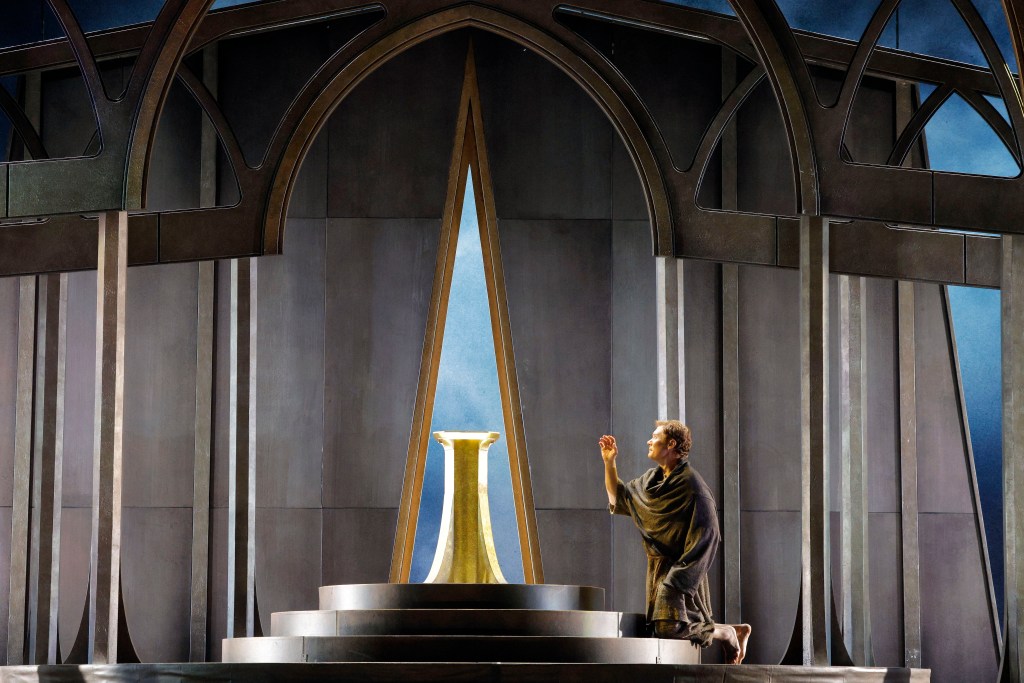
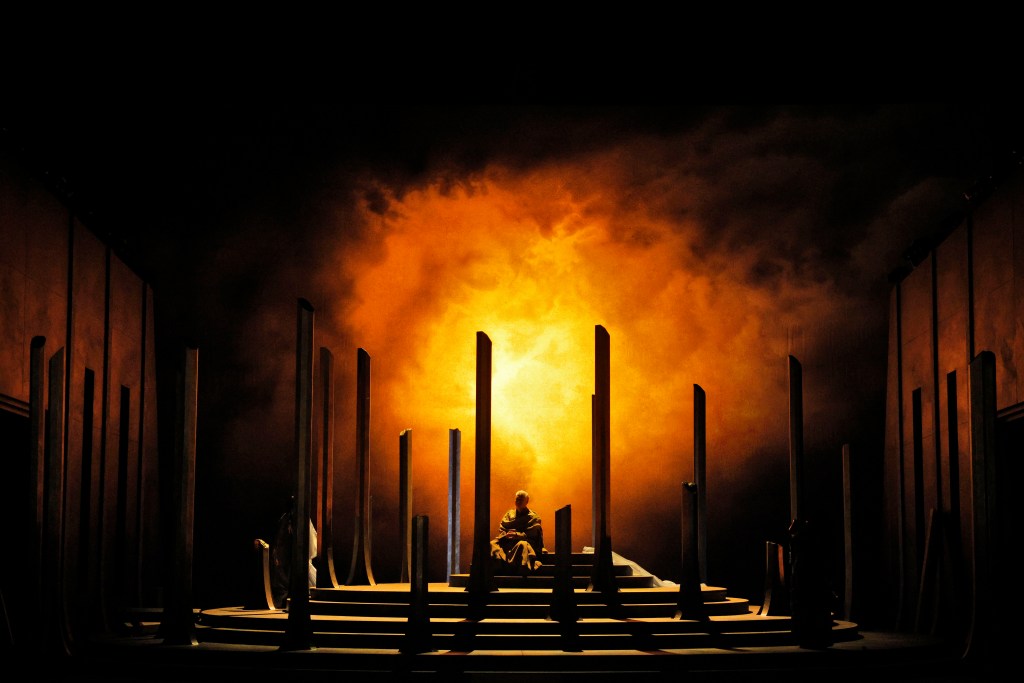
The third performance of Parsifal (Act III, Scene 1 pictured, photograph by Cory Weaver) San Francisco Opera was yesterday afternoon. I was lucky enough to attend this opera in Box Z, which is pretty much as close as one can get to the stage. Again, new details revealed themselves, and as always, it was fascinating to watch the orchestra and Maestra Eun Sun Kim.
On Saturday, the Wagner Society of Northern California hosted a talk by Professor Thomas Grey entitled Outside/Inside: Sacred Spaces in Parsifal that I attended and it made me notice that the three dancers in Act I Scene 2 were fluttering their hands to represent the Holy Ghost.
I did spend most of my time watching Maestra Kim and the orchestra and was very much impressed by the woodwind and string soli. The brass were right under me and it was interesting to feel the vibrations of the instruments in my body.
Mezzo-soprano Tanja Ariane Baumgartner is growing on me, her voice is not beautiful but it is appropriate for her role and her German diction is exceedingly clear.
* Tattling *
The line to get into the opera house was quite long at noon, and someone jumped ahead, causing great dismay.
There was a lot of electronic noise, in Act I it sounded like either a cellular phone had a chiming ring or there was a hearing aid having lots of feedback, but it lasted for a long time, which makes me suspect it was the latter.
Two rings were also heard in Act III during some quieter moments.
 September 12–27 2026: Simon Boccanegra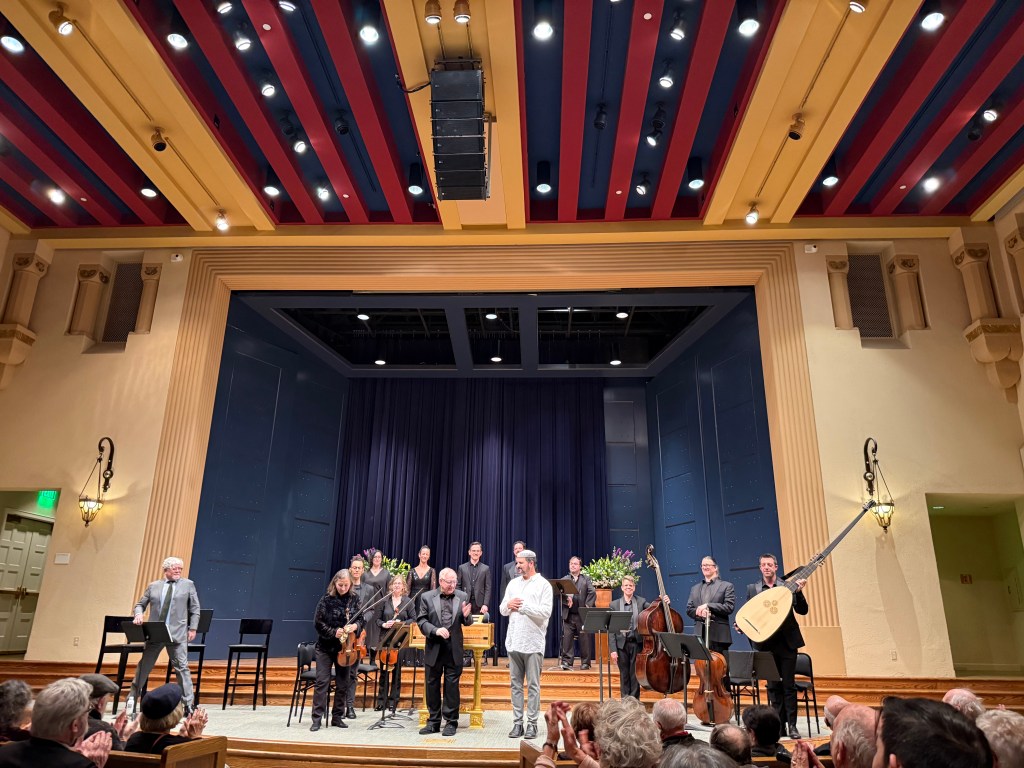


 The Opera Tattler
Leave a comment